
The JOURNAL, Queen’s University, April 15, 2006
F is for Fork & second-wave feminism, History and Domesticity dominate exploration of gender roles at Agnes. Sept 8, 2006 Joanna Nicholson
Fine Arts Review: slow boil @ Agnes Etherington Art Centre until Oct 29
Two artists revisit the issues of second- wave feminism through a small exhibition in Agnes Etherington Art Centre’s Frances K. Smith Gallery.
Mary Rawlyk, a Kingston native, and Martha Rosler, a video artist from the U.S., Have collaborated to produce slow boil, which examines domesticity and the role of women through video, printmaking and etching. Rosler’s 1975 video, “Semiotics of the Kitchen,”is the exhibit’s centrepiece, displayed on a rich ,red wall at the front of the intimate gallery.
The exhibit’s Curator, Jocelyn Purdie, perfectly captures the film’s mood by describing it as a “deadbeat show -and-tell “ of Kitchen Utensils and their applications. Rosler displays a kitchen object or utensil by going through the alphabet and performing a simple action. For example, at the letter “F,”she takes a fork and makes violent jabbing motions.
Rawlyk’s series of eight etchings and prints line the rest of the white gallery space. The red coil of a stove top burner, occupies the bottom half of her first piece: a 1973 print entitled “Boiling.” Above the burner sharply contrasting with its black background, light blue bubbles rise to the top.
Not simply a representation of a practical household object, it also suggests the building frustration of women encountering limited opportunities during the 1960sand ’70s, much like water eventually coming to a rolling boil. This piece compliments the exhibit’s title and successfully summarizes its message.
“Measuring Cup Woman” also places a household object at its centre. In this piece, a photograph of a solemn- faced woman is curled up inside the measuring cup, limited and literally contained by her domestic role. While Rawlyk’s prints are bland in appearance, though compelling in their content, her four etchings are much more aesthetically pleasing. Highlighting the chores of ironing, wringing shirts, sweeping and sewing, they juxtapose colour with black-and white and use angular, geometric shapes.
The intense contrast between light and dark emphasizes the conflict between the expectations placed on a woman as the primary housekeeper and her reactions to the role: The light sections depict her daily tasks, and the dark section reveals the depressing side of the chore. The black portion of “Sweeping” includes dirty footprints, baby blocks and clothespins on the floor. Harsh broom bristle marks are also scratched into the print as a hostile response to the performance of the chore.
Slow Boil forces viewers to explore the definition of gender roles. In Purdie’s introduction to the exhibit, she writes that the display is particularly relevant at a time when “domestic violence and reproductive choice are on the political agenda in Canada and the United States” once again.
It is not often that Artists practising in different mediums are able to complement each other as wonderfully as Rosler and Rawlyk. Their pieces interact, intersect and, in the process, sharpen each other’s message.
ATLANTIS 1986 Exerpt from the review by Kathy Brown, of the exhibition of prints and drawings by Mary Rawlyk, at Mount St. Vincent University Art Gallery, Halifav, NS.
Mary Rawlyk: The Domestic Experience
This is a feminist exhibition. Mary Rawlyk has struggled for years to find time to make art. Her family life is busy and complex. She is often angered by the juggling act she must engage in, and by the invisibility of much of the domestic work she performs. While the house runs smoothly, no one notices the housewife’s effort. Though Rawlyk has over time been able to extricate herself often enough to gain training and to produce a body of work, the frustration remains. And she realizes that many women are in a far worse position.
Since the work in this exhibition erupted out of anger, one expects to see wild Expressionistic prints. Not so. As Rawlyk writes in beginning her catalogue essay,” For as long as I can remember I have enjoyed colour and light and form, and have found pleasure in line and texture and spatial arrangement.”
It is out of these and out of the domestic objects she sees every day that she makes her statement. Her images are carefully thought out, their strength arising not from wildly expressive abandon but from intelligent execution.
Earlier from 1972 to 1978 when making art was particularly difficult, she had turned to depicting domestic objects in her prints. These early works, the Domestic Object Series had a formalist approach to the subject. They did not express much of Rawlyk’s feeling about her situation. Then, through reading, she discovered that she was not the only housewife to feel dissatisfied and frustrated, and that other artists, especially in the U.S. were using the domestic experience as subject matter. By 1980 she was ready to make prints directly related to her experience as an artist/housewife- housewife/artist.
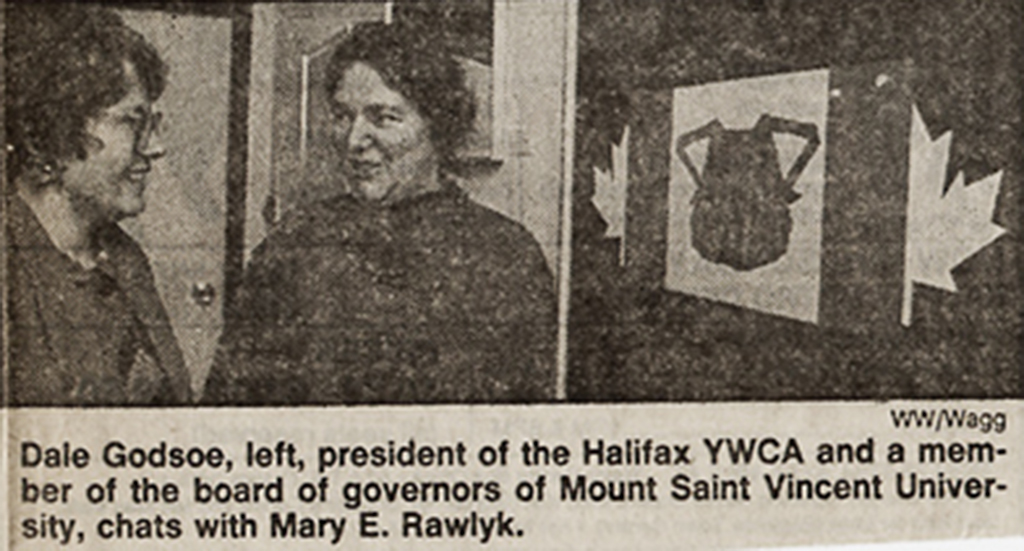
Her first efforts, begun in 1981 are included in this exhibition. The Housewife Series mates colour xerox transfer prints of Rawlyk’s face with images of common domestic objects produced by various intaglio printing processes. Egg woman watches helplessly while the eggs (chicks) leave the box(nest). If the box closes she’ll be crushed. Cake Rack Woman is obviously in jail. Measuring Cup Woman reflects on her fate. Rawlyk used her own face because she did not feel that another woman would want to be depicted this way. Indeed, these images are almost repellant in their anger. Woman is entrapped by her domestic role, there is hope. The most moving image in this series is Canadian Apron Flag, the Canadian Flag centred by a red apron rather than a maple leaf.
This image was born after Margaret Mitchell was ridiculed in the Commons for bringing up the issue of wife battering and produced during the uproar over the inclusion of women’s rights in the Constitution. This was an especially discouraging time for Canadian women, and the Housewife Series reflects this.
While producing this series Rawlyk was searching for a symbol which would symbolize womens’ housework more universally. The domestic objects and the self-portrait aspect of the Housewife Series were too closely linked to the artist herself. By process of elimination, she chose aprons, the ordinary non-bib kind which tie around the waist. The Apron Series is her most successful statement. These prints work on many levels. They are finely designed and executed images and they are replete with feeling.
The prints in the Apron Series are admirable for their invention. Rawlyk carefully arranges the apron on an inked plate and runs it through the press. She then lays her print making paper on the resulting ink image and reruns the plate to make her apron print. The print shows the weave, the crumples, the folds, the sewing and embroidery details of the original apron. Rawlyk adds to the image with hand colouring and sometimes, further printing. The black background is achieved through a stencil print. These are monoprints essentially, though small runs of three to six almost identical images are possible. In this case Rawlyk terms the set of prints “variations” rather than an edition.
All this attention and care is lavished not to produce an intriguing image, but to make a statement. The hands appended to some of the ties are a key element. They humanize the image. These are not just aprons, they are symbols for every woman who has sunk into a chair exhausted at the end of a domestic day. Angry Red Apron, Blue headache Apron, Hanging Green Apron and their companions express the problems of domesticity in a poignant manner, with which viewers, both female and male, identify. Most of these images need no titles or interpretation. The message is clear. We are all forced to examine our own attitudes and feelings about this absolutely necessary, yet still undervalued aspect of daily life.
Pink Proposal Apron expresses the essence of the female dilema. Two cross-stitched figures, male and female, seem to symbolize the marriage proposal with its romance and promise.The apron itself symbolizes the domestic role attendant to the acceptance of marriage and the possibility of a family, a role which nearly always falls on the woman. It’s the unusual woman who recognizes this feature of the situation. The apron seems to say “I didn’t know what I was getting into!”
The aprons are printed in soft colours. In themselves they are gentle images. The black background gives them punch and carrying power. Without it they would retreat into the white walls of the gallery, It is the background which delineates the apron ties and the hands which so often make the statement.
Women’s contribution to the common good through domestic labour remains largely unrecognized. Rawlyk pushes for redress. These prints, individually and en masse, are a powerful statement. They communicate their message visually. They don’t need verbal explanation…
…in many respects, this is an important exhibition. It expresses the feelings of a very large proportion of Canada’s population in a way that can be understood by many and with a force and directness difficult to reach in methods less immediate than the visual.
The CHRONICLE – HERALD
THE MAIL STAR 1986 exerpts from a review by Elissa Barnard of the exhibition of prints and drawings at Mount St. Vincent University, in Halifax, Nova Scotia
Material omitted here, described work by another woman artist which was shown concurrently.
…Rawlyk speaks from her 25 years of experience as a homemaker, She expresses the frustrations of the isolated housewife in prints of aprons and prints of her own face trapped inside a measuring cup or a carton of eggs…
In Rawlyk’s hands, the apron is a brilliant symbol for women trapped in the home. The aprons in her monoprints are faded, every wrinkle and stitch is visible, and they appear like dried, crushed flowers. Spots of glowing orange/yellow colour in the aprons are the only expression of anger and life.
Rawlyk, who works in her home in Kingston, Ontario, uses the ties as arms, sometimes with colour Xerox hands attached, and the aprons become women expressing anger, devotion, futility and exhaustion. Two hands at the ends of a bow grab in a kind of scream towards the Apron’s skirt in grey Struggling Apron; in the ironic Pink Proposal Apron, Rawlyk expresses how young women’s dreams of romance have historically ended in domestic drudgery. Here the apron’s arms rest on the hips of a skirt which contains an embroidered sampler-like, scene of a gentleman talking to a lady.
More direct than the Apron Series, is the witty and emotionally charged Housewife Series, brought about in 1981 when Rawlyk accidentally dropped a photograph of her face into a measuring cup.
Rawlyk makes the photograph, in which she looks tired and burdened, part of kitchen objects to “show how women become incorporated into their domestic labour.,” she writes in the catalogue essay. Her prints, with a stark black and white background, of her face imprisoned behind a cake rack or trapped on a shortening package’s label are comic and scary.
Rawlyk, whose show is organized by the Robert McLaughlin Gallery in Oshawa, is important as a voice for women who have long been silent.
Appraisal
By Carla Garnet 1982, Appraisal provided to the Canadian Cultural Property Export Review Board, who after considering 23works, concluded that the works of Mary Rawlyk “meet the required criteria for “outstanding significance and national importance.”
“Both Joyce Wieland and Mary Pratt are better known than Mary Rawlyk although in time, her work may be considered as important or more so because Rawlyk’s work is much like that of Hannah Hoch. Hoch was little known in her lifetime and now is considered most remarkable for challenging accepted social and artistic values early in the 20th Century and for the innate sophistication she brought to her craft. Rawlyk like Hoch addresses issues like gender-typed roles and visual marginalizing of women using montage.”